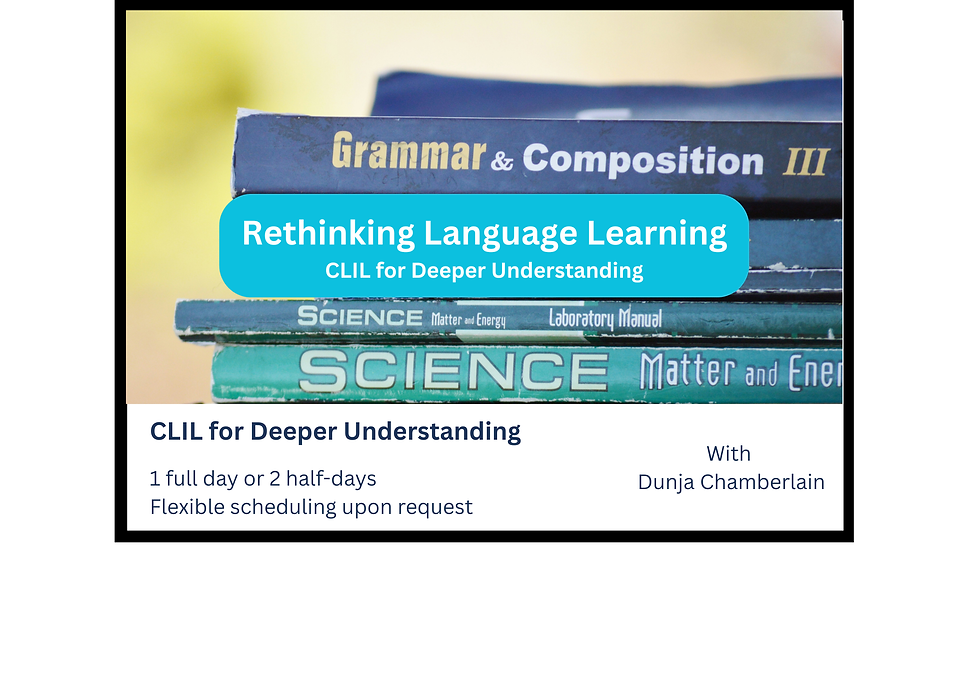
CLIL and Beyond: Pluriliteracies for Deeper Learning through language
From
CHF 3,000.00
Excluding VAT
As a school leader, you want students to do more than memorise content. You want them to understand concepts deeply, express their thinking clearly, and thrive in multilingual learning environments. Yet in many classrooms, linguistic barriers, limited academic language, and a focus on factual recall prevent students from reaching their full potential.
This 2-day CLIL & Pluriliteracies conference gives your teachers the tools to change that. It provides a coherent, research-based framework that helps students learn content and language simultaneously while developing the cognitive, communicative, and reflective skills required for deep learning.
Designed for primary and secondary teachers across subjects, this conference offers practical strategies that immediately strengthen instruction, elevate student outcomes, and create more inclusive, language-aware classrooms.
FOR YOUR SCHOOL, THE BENEFITS ARE SIGNIFICANT AND LASTING
1. Stronger learning across subjects and languages
Your teachers learn how to use CLIL and the 4Cs to make content accessible even when students lack the required language. This improves comprehension, reduces frustration, and ensures all students — including EAL and multilingual learners — can access the curriculum.
2. Deeper conceptual understanding
Through the Pluriliteracies framework, your teachers learn to move beyond teaching facts toward “learning through understanding.” Students learn to connect concepts, co-construct meaning, and transfer knowledge, skills that directly improve assessment results.
3. Higher-quality academic communication
Your teachers explore disciplinary genres, communication modes, and language functions so students can produce clearer explanations, arguments, commentaries, lab reports, and more. This strengthens written and oral expression across the school.
4. Inclusive and student-centred classrooms
The conference equips your teachers with strategies to scaffold language, support hesitant learners, create low-anxiety environments, and promote learner agency. This is essential for diverse, mixed-ability, and multilingual settings.
5. A shared pedagogical language across the school
CLIL and Pluriliteracies give your departments a common framework for planning, instruction, and assessment. This builds consistency, strengthens curriculum alignment, and enhances whole-school teaching quality.
6. A more reflective, engaged student mindset
Your teachers learn how to make thinking and metacognition visible, helping students express their understanding with clarity and confidence, regardless of their language level.
PROGRAMME OVERVIEW
DAY 1 — CLIL & Pluriliteracies: Co-Constructing Knowledge
CLIL definition & the 4Cs framework
What is Pluriliteracy?
Language OF learning
Strategies for students who lack the language of instruction
Making procedures explicit
How concepts lead to deep understanding
Teaching strategies that prioritise understanding over memorisation
DAY 2 — Pluriliteracies: Demonstrating Understanding & Learner Mindset
Language FOR learning
Choosing the right style, genre, and communication mode
Characteristics of disciplinary genres
Language functions and their purposes
Language THROUGH learning
Creating low-anxiety learning environments
Deep learning through relationships and reflection
Enhancing language for mastery
Call to Action, Feedback & Q&A
Audience: Primary and/or secondary teachers
Duration: 2 full days
Dates: upon request Certification: Certificate of Mastery
Please provide the location of your institution (if delivery method is "in-person"). (optional)
Course language
This course is in English.
Delivery method
Online, led by an instructor (Zoom) or in-person.
(If in-person, the fee will correspond to the indicated course price, with additional costs for transportation, meals, and accommodation if necessary.)
Instructor
Dunja Chamberlain